

How to Start Indoor Saffron Farming in India: Complete Step by Step Guide to Grow, Harvest & Sell

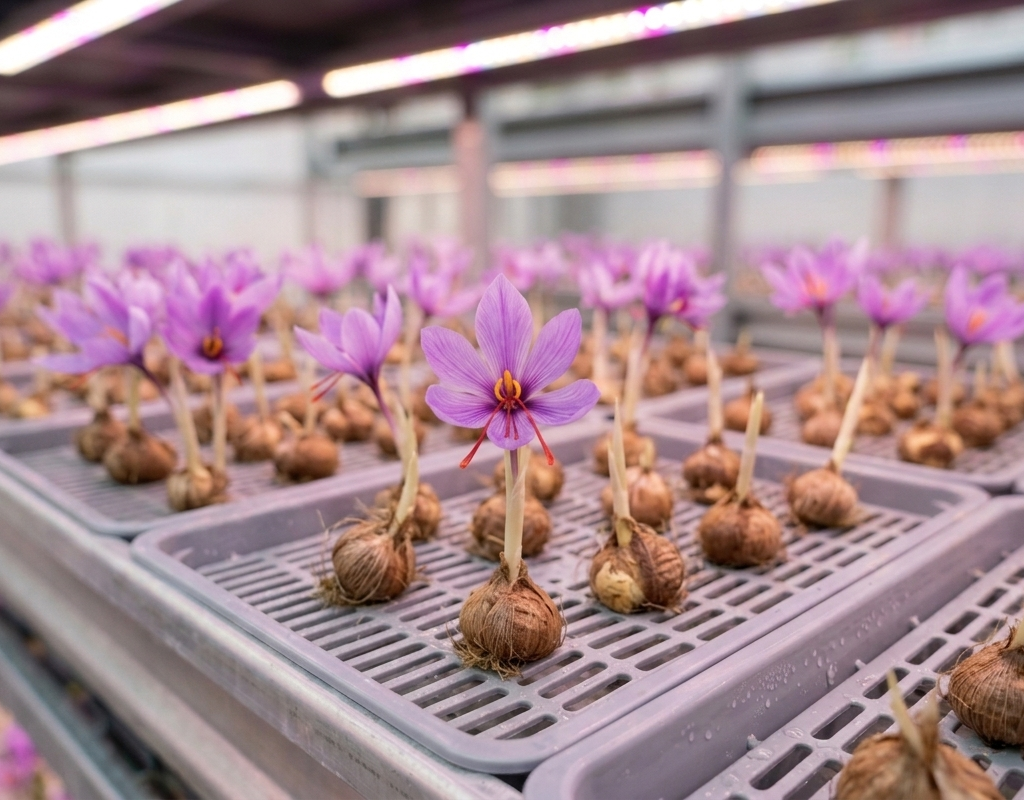
If you want to understand whether indoor saffron farming actually works in India, this guide will give you straight answers. We are Coming from a family with 4 generations of agricultural experience,
I’ll break down everything
Indoor aeroponics saffron farming setup,
Indoor saffron farming investment needs,
Expected Saffron farming yield,
Saffron farming risks and profit without sugar-coating anything.
Let’s dive into saffron farming world,
Let’s first understand what saffron or Kesar is? Farmers dry the red threads of purple saffron flowers to produce saffron. Because each flower yields only 2–3 threads, harvesting is highly labor intensive.
People call saffron red gold because of its deep color, rich flavor, and very high price. In India, you have a question : how much is saffron? Its price is approximately ₹1.5 – ₹4.5 lakh per kg, it is the world’s most expensive spice.
In addition to its taste and color, saffron also has several other benefits, including support for the mood, digestion and antioxidants.
The Biology of Crocus sativus (Saffron Crocus)
I’ll tell you about the saffron plant, and why it is so difficult to grow.
You will gain insight into the growth of Crocus sativus, the physiological process of flowering stage and the reason for low yield.
The saffron crocus, or Crocus sativus, is the source of saffron. Unlike most spice plants, saffron does not produce seeds.
It emerges from an energy storage bulb under the ground (saffron corm). Croculus corms are the corms of these saffron plants and resemble a saffron bulb. Many farmers refer to them as saffron bulbs or crocus sativus bulbs, but corm is the proper term.
The saffron corms flower in the autumn with a stem and purple flower, each with 3 red stigmas. This flowering phase is brief and only lasts for a couple of weeks. Therefore, Farmers must hand-pick the saffron flowers every morning during the flowering stage to preserve their quality.
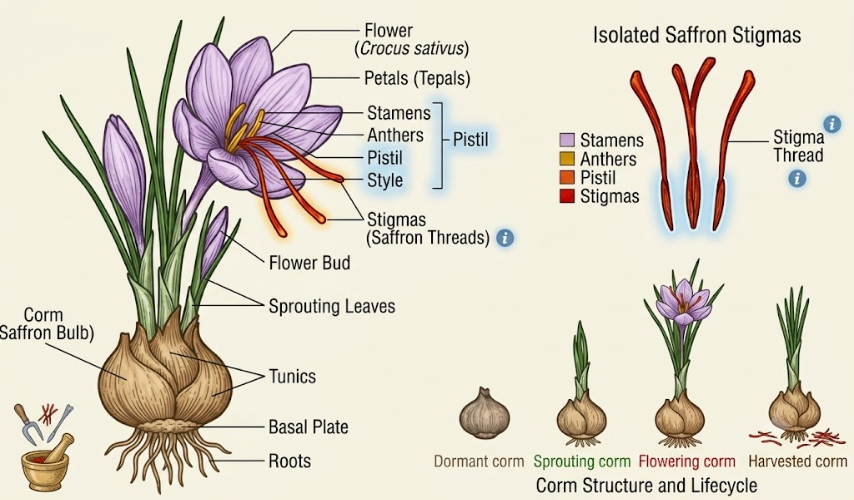
The flower gives only three thread and each flower of the plant produces only one flower. As a result, Farmers need about 150,000 to 250,000 saffron flowers to produce 1 kg of dried saffron because the crop has a limited yield.
Plants grow by vegetative propagation – mother corms producing daughter corms. This multiplication will help farmers increase their plantings through healthy seed grade corms to yield more plants and flowers.
Why Is Saffron So Expensive?
Many people ask, how much is saffron? How is it that this saffron spice is so expensive? The expensive it is not only because of the high cost, but also due to the hard labor, low production and challenging growing conditions.
Quality, purity and geographical origin are the most important factors that determine the price of saffron. The higher quality Kashmiri saffron price in India generally ranges from ₹2.5 lakh to ₹4.5 lakh per kg. The wholesale saffron prices are relatively cheaper, which varies depending on the grade, approximately ₹50,000-2.5 lakh per kg
The reasons behind the expensive price of saffron:
- It takes about 150,000 to 2,50,000 flowers to produce 1 kg of dried saffron.
- It takes 400+ hours of hand labour because every stigma is picked manually.
- Blooms will only last 1-2 days, so quick harvest is necessary.
- Saffron can only be cultivated in special climates where the winters are cold and the summers dry.
If you are curious about how much is saffron in small sizes, you can expect to pay ₹300–₹600 per gram.
For bulk buyers checking saffron price per kg, mandi rates may look much cheaper. Some recent data showed saffron at ₹15,000–45,000 per kg, but this is likely lower-grade or blended saffron, not pure Kashmiri Mongra. Always compare quality before comparing prices.
The premium price of saffron in India per kg, especially for Kashmiri Mongra, is usually around ₹2.5–4.5 lakh per kg.
Grades of Saffron: Mongra, Lacha and Zarda
Not all saffron has the same quality. Its grade affects colour, aroma, purity, price, and even saffron benefits.
Here’s a simple breakdown of the main saffron grades:
- Mongra (Lacha): Pure red stigma, hand-picked. Highest grade with the strongest colour, aroma, and maximum saffron benefits.
- Lacha: Red stigma with a small yellow part attached. High quality but slightly less powerful than Mongra.
- Zarda: Mostly yellow style with very little red. Lowest grade with weak colour and flavour.
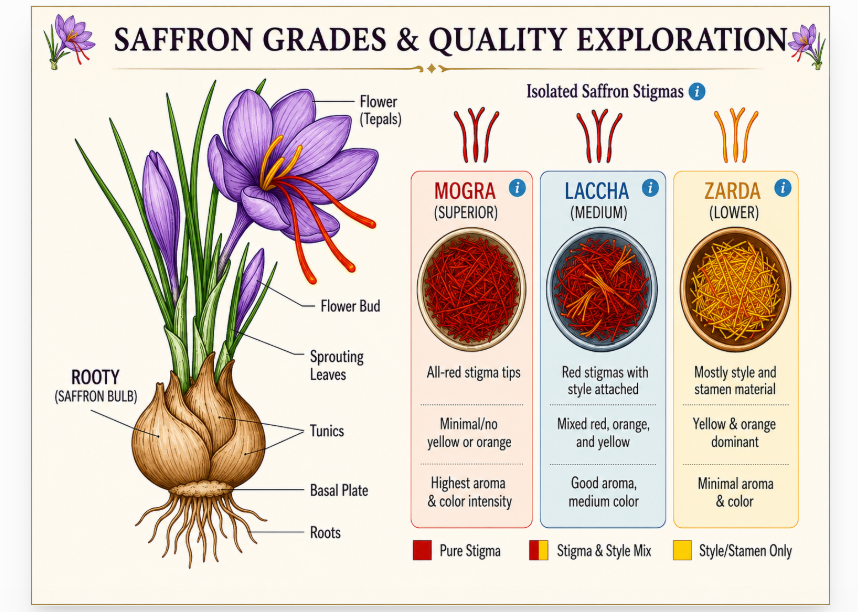
For growers buying seed grade corms, remember saffron grading is only for the dried spice, not the corm. Corm quality depends on size and health.
This is also why saffron is called the red spice – the redder the thread, the better the grade and price.
Traditional Saffron Farming in India
The traditional saffron cultivation in India has been going on for more than 2500 years and it is primarily practised in Kashmir. Indeed, saffron cultivation in India is inextricably intertwined with the state of Kashmir that many tend to equate them with.
People often ask, which Indian state is traditionally famous for saffron cultivation?
The answer is Jammu & Kashmir and in particular, Pampore, the saffron town of India. This is a traditional farming technique that relies entirely on open field farming, rainwater, labor and knowledge transmitted from generation to generation. There is no greenhouse setup or automation in traditional saffron farming.
Fun Fact: Historians think it was Central Asian traders who brought saffron cultivation to Kashmir, way back around the 1st century BCE. They probably came via those ancient trade routes from Persia.
Global Saffron Production and India’s Position
Before we understand Kashmir’s challenges, we should also know where people grow saffron outside India.
Saffron is mainly harvested in Iran. Other leading producers are Afghanistan, Spain, Greece and Morocco. India is still a minor producer, but Kashmir saffron is known for its top quality.
Kashmir’s Saffron Production Decline
In the past few decades, production of saffron has been dwindling in Kashmir.
The area under cultivation dropped from 5,707 hectares (1997) to 3,500 hectares (2017), and later to 3,665 hectares (2025).
Production has also become unstable:
- 2020–21: 17.33 MT
- 2021–22: 14.87 MT
- 2022–23: 14.94 MT
- 2023–24: 23.53 MT
- 2024–25: 19.58 MT
Some bad seasons saw production fall to only 2–3 tonnes. The clear takeaway is simple: traditional saffron production is showing a long-term decline with major yearly fluctuations.
Root Causes Behind Decline
There are multiple issues that are impacting traditional farming at the present.
- Climate and weather: Irregularities in the weather, rising temperatures and unseasonal heat disrupt the cold dormancy that is required for saffron.
- Cold shock: Temperature changes may cause damage to flowers before they are fully mature.
- Water shortages: Saffron is sensitive to the timing of precipitation, but in extreme weather events, this is difficult to guarantee.
- Irrigation issues: In many instances, adequate irrigation is still not being provided. Although farmers have irrigation systems, such as drip lines in many cases they report that they never receive water to the fields.
- Land loss: Traditional karewas are shrinking because of housing and infrastructure growth.
- Labour intensive: Saffron farming is very labour intensive, involving in land preparation, sowing and selection of quality planting material.
Why Traditional Farming Can’t Meet Saffron Demand
Although the government supports their farming of saffron, yet at all levels, the farming of saffron is not growing in scale. Still low productivity due to the reliance on weather for farming, which makes it difficult to guarantee higher production in general.
Another major issue is labour. Hand-harvesting of saffron is very labour intensive, which limits how much land one family can manage. This is why reduced labour through better technology is becoming important.
That is why many growers now see indoor cultivation as a viable solution. It enables them to produce a more reliable and profitable saffron crop. In partnership with Sher-e-Kashmir University of Agricultural Sciences and Technology (SKUAST-Kashmir), NABARD also conducted indoor farming trials to evaluate how controlled cultivation could solve the challenges that open-field farming could not address.
What Is Indoor Aeroponic Saffron Farming?
Indoor aeroponic saffron farming is a modern way to grow saffron without soil and without depending on weather or Kashmir’s shrinking farmland. Saffron can be grown within a closed room, anywhere in India, using the indoor aeroponic saffron method.
In indoor aeroponic saffron farming, saffron corms are placed in trays or racks, while roots stay suspended in air and receive nutrient mist. This method of aeroponic farming allows for continuous harvests and can save 90% of water.
This technique belongs to CEA (controlled environment agriculture), which is when farmers monitor and manage their own temperature, light and humidity. This controlled environment saffron model uses controlled environment technology, often combined with ai for agriculture tools and smart agriculture sensors to automatically monitor temperature and humidity.
What Is Aeroponics? A Simple Explanation
So, what exactly is Aeroponics? It means growing plants in air instead of soil.
Here’s how the aeroponic system works and why it matters.
- The corm is placed in a tray with roots hanging freely.
- A pump sprays nutrient mist on roots every few minutes.
- No soil means fewer pests and diseases.
- More oxygen reaches roots, helping better growth.
- The aeroponic system is compact and works well in small spaces.
Researchers are still developing aeroponics in India and are already testing it for high-value crops. Unlike NFT hydroponics, which keeps plant roots immersed in flowing water, aeroponic farming keeps the roots suspended in open air while growers feed them with nutrients through a fine mist.
Indoor vs Traditional Saffron Farming: Key Differences
In indoor cultivation, everything that once depended on weather now depends on equipment. This makes urban saffron farming possible—you no longer need Kashmir’s karewa land, just a properly controlled room anywhere in India.
Traditional farming practices depend on seasons and rain, whereas the farming indoors depends on controlled conditions set by the grower. Machines not geography control important environmental conditions such as temperature and humidity. This controlled environment minimizes risks of frost, drought and other sudden environmental changes.
Aeroponic vs Hydroponic vs Traditional Saffron Farming
It would be useful to compare the principal farming systems to gain some insight into the reasons for the better understanding of the indoor methods. These methods are different in different circumstances and are specific to different setups.
Traditional farming is done in soil and relies on natural weather.
In hydroponic Farming, plants are cultivated without soil. They do require nutrient rich water and their roots use hydroponics systems that provide all of the plant’s needs.
Aeroponic farming is different. In this case, the plant’s roots are exposed to air and the plant gets its nutrients from a fine mist of water or nutrients rather than soil.
| Factor | Traditional (Soil) | Hydroponic | Aeroponic |
| Growing medium | Open soil | Water-based | Air + nutrient mist |
| Water use | High | Medium | Low (up to 90% less) |
| Location flexibility | Fixed to Kashmir climate | Indoor possible | Indoor possible |
| Labour | Very high | Medium | Lower, more automated |
| Setup cost | Low | Medium-high | High |
One of the possible methods in saffron hydroponic farming is the vertical hydroponics tower, wherein water is used for providing nutrients. In Vertical Aeroponics, the nutrient mist is sprayed instead of water on a vertical aeroponics tower or rack.
Both methods are a part of vertical farming particularly vertical saffron farming in which many layers are stacked up to conserve space. These modern systems are often called saffron tech, where engineering helps solve traditional farming problems.
Indoor Saffron Farming Setup Formats Available in India
Indoor saffron setups in India vary based on budget and scale. Most saffron farmers begin small and expand after learning the process.
Here are the most common setup types used today:
- Multi-tier racks: Multiple racks holding saffron trays of corms to maximize space.
- Indoor setup in a spare room: A basic indoor setup using a small room, room controlled lighting, and a cooling unit as a simple grow module.
- Cultivation chambers: Commercial growing chambers Fully insulated with grow lights, humidity control, and airflow for commercial farming.
Can You Grow Saffron Indoors in India?
Yes and it’s been proven by science. So, can saffron be grown outside Kashmir? Yes, if Kashmir-like conditions are created in an artificial manner.
So, can I grow saffron at home in Mumbai, Hyderabad or Gujarat? Technically YES.
How do you grow saffron : indoor growing of saffron is dependent primarily on four factors such as temperature, humidity, light and quality of saffron corm.
The Science Behind Indoor Saffron Cultivation
The goal of controlled environment saffron farming is simple: make the plant feel and think like it is still in Kashmir.
This requires precise controlled conditions and stable environmental conditions. Humidity control is especially important during flowering. For serious setups, industrial HVAC (Heating, Ventilation, and Air Conditioning) systems are often used to maintain cold temperatures around 5–10°C, because normal home ACs may not be enough.
Government & Research Findings on Indoor Saffron Farming
Indoor saffron farming is backed by real research, not guesswork. The NABARD project with Sher-e-Kashmir University of Agricultural Sciences and Technology started indoor saffron trials in 2018, with a funded project running from 2021–2024 to improve productivity and quality.
Another research lab in Telangana’s Wanaparthy successfully grew saffron using aeroponics in a 200 sq ft lab by controlling temperature, humidity, light, and CO₂. This Kesasr Farming research is now helping smaller kesar farming at home setups across India.
Where Indoor Saffron Farming Is Already Working in India
Out of research labs, indoor saffron is being tried by actual growers. Around five farmers in Pampore and Budgam districts have adopted the indoor farming model under the NABARD project. Telangana’s horticultural university has also successfully cultivated saffron without soil, aiming to make the state a new saffron production hub, showing that this isn’t limited to Kashmir’s climate at all.
Realistic Limitations of Indoor Saffron Farming
Before jumping in, understand the real challenges:
- Cost: Equipment, especially cooling systems, makes the initial investment high compared to open-field farming.
- It remains genuinely labour intensive in the corm-handling stages, even though daily harvesting labour is reduced.
- Corm multiplication indoors is still tricky — while flower cultivation is possible in any state, the real challenge comes after flowering when the seed undergoes vegetative reproduction, and that stage is still being worked out scientifically.
- It’s currently a promising but still-developing viable solution, not a guaranteed one — go in with realistic expectations.
How to Grow Saffron at Home: Step-by-Step Guide
This step-by-step guide is useful if you want to learn how to grow saffron at home or how to grow saffron indoors. If you wish to cultivate saffron on your own roof for your own needs, or if you wish to initiate saffron farming at home as a small business, both are the same.
A lot of the people who are new to the procedure often look for how to grow safron (they have mistakenly typed saffron), but it is the same procedure. The key is proper planning, quality corms and a controlled environment.
Follow these 10 simple steps
Step 1: Planning
The first step to starting a saffron farm is to determine the scale. Do you want to grow saffron at home as a hobby or are you looking to expand your saffron farm and make it a profit?
Planning helps you understand:
- Room size needed
- Initial budget
- Expected saffron crop production
- Personal use vs selling
A clear plan makes your saffron crop management easier and avoids expensive mistakes later.
Step 2: Select and source saffron corms
Saffron is not grown from true seeds, many people dig for saffron seeds. It grows from corms.
Always make sure that the saffron corms used for growing saffron at home are healthy and of good quality of seed grade.
A quintal (100 kg) of corms can cost around ₹40,000 to 80,000. For smaller growers checking saffron seeds price or saffron seed price, costs depend on quantity.
When not growing in aeroponics, people may be asking themselves which kind of soil they should use for growing saffron; the answer is well drained, sandy loam soil that is very aerated.
One of the most essential steps in saffron farming at home is this.
| Corm Size | Flowering Potential | Expected Performance |
| Small | Low | Produces fewer flowers and lower saffron yield. |
| Medium | Moderate | Produces a moderate number of flowers with average yield. |
| Large | High | Produces more flowers and generally offers the highest saffron yield. |
Step 3: Prepare the growing room
If you want to grow saffron at home, you should have a separate small room that serves as the growing space.
This room should act as a:
- grow module
- indoor setup
- insulated growing space
- sealed cultivation chambers
A proper indoor environment is essential when learning how to grow saffron indoors.
Step 4: Install the Aeroponic System
For efficient indoor cultivation, install an aeroponic system.
This usually includes:
- multi-tier racks
- growing racks
- planting trays
- misting units
This is the idea behind vertical farming that it helps you to maximise your space and get more production.
This setup makes how to grow saffron indoors much more efficient.
Step 5: Climate Control & Automation
Climate is the most important part of saffron farming at home.
Your setup must include:
- proper humidity control
- reliable industrial HVAC
- quality grow lights
- a fixed watering schedule
Correct watering routine or schedule ensures healthy corms. Excessive watering can lead to fungal diseases.
Care must be taken in monitoring temperatures and moisture to prevent fungal diseases.
Modern ai for agriculture tools and smart agriculture systems can help with crop monitoring by sending alerts.
Good crop monitoring reduces labor and improves success rates.
Step 6: Flower Induction
This stage triggers the flowering stage.
To start flowering, corms need cold treatment between 5–10°C for a few weeks.
After that:
- buds start forming
- the flower emerges
- full flowering begins
This stage usually lasts 2–4 weeks.
Step 7: Crop Monitoring During Growth
During active growth, daily crop monitoring is critical.
Check this:
- if your watering schedule is stable
- signs of fungal diseases
- flower development
- expected yield
Regular crop monitoring helps detect issues early and improves final yield.
Step 8: Harvesting the Stigmas
Harvesting saffron must be done early in the morning when flowers are closed.
To harvest saffron, it is a simple procedure that is delicate:
- Pick the flower carefully
- Open it gently
- Remove the three red stigmas by hand
This manual process is the core of how to harvest saffron.
Good harvesting practice ensures quality and enhances market value of the saffron.
If you’re looking for a how to make saffron, then the next step is to dry these stigmas.
Step 9: Drying and Storing Saffron
Drying of the saffron starts after harvest.
When saffron is dried the right way, low heat is used to maintain the aroma, flavor and color of the spice.
Properly drying and storing saffron is crucial.
Best practices for storing saffron:
- airtight containers
- dark storage
- moisture-free environment
- use of cold storage systems for bulk storage
Cold storage systems are frequently used on large farms to preserve quality and shelf life.
If you have no idea how to use saffron, steep a few threads in warm milk or water to release the colors before incorporating into dishes.
Step 10: Post-Harvest Corm Management
After the season ends, focus on corm multiplication.
Saffron reproduces vegetatively by the production of new corms from old corms.
Proper corm storage helps:
- increase next season’s yield
- maintain healthy stock
- expand your saffron farm
Good post-harvest management directly impacts your future saffron crop and long-term profitability.
Indoor Saffron Farming Setup Cost by Scale
Understanding saffron farming costs India early helps you plan better and avoid unexpected expenses.
The total cost and investment are primarily dependent on the size of the set-up, and in saffron cultivation, the saffron corms, infrastructure and coolers are the major expenses.
| Scale | Growing Area | Estimated Investment |
| Small Scale | Up to 50 sq. ft. | ₹1 lakh – ₹3 lakh |
| Semi-Commercial | 51–100 sq. ft. | ₹3 lakh – ₹9 lakh |
| Commercial | 101–500 sq. ft. | ₹10 lakh – ₹50 lakh |
Small-Scale Setup (Home / Startup)
The basic requirements for a small home setup are a converted room, some basic racks, cooling (Heavy-duty AC or chiller), saffron corms and utility connections.
It costs about ₹1-3 lakh based on the experiences of the Kashmir indoor pilot farmers.
If you live in warmer states, you’ll have to pay more, depending on how much cooling is required.
Medium Commercial Setup
At this level, automation becomes more important for stable saffron crop growth. You typically need:
- Proper HVAC systems
- Multi-tier growing racks
- Basic climate monitoring sensors
A 100 sq. ft. setup with climate control may cost around ₹6–9 lakh. However, this estimate comes from a limited industry source, so treat it as a rough benchmark.
Large Industrial Setup
Industrial-scale saffron cultivation uses full climate automation and advanced systems for yield optimization. These setups usually include dedicated facilities and research-based growing methods.
So, for example take research labs in Telangana – they’re working on this level, and just to give you an idea, their tiny 200 sq. ft. aeroponic lab ended up costing a whopping ₹13 lakh to set up.
Monthly Operating Costs
Ongoing expenses mainly come from electricity, especially for industrial HVAC, since climate control runs continuously.
Typical monthly operating cost for a 100 sq. ft. setup is estimated at ₹10,000–₹15,000, though this is based on industry estimates, not official government data.
The process is still labour intensive, especially during flowering and harvesting, even though daily maintenance costs are usually lower than traditional open-field farming.
| Operating Expense | Cost Impact | Why It Matters |
| Electricity | High | Must operate the heating, cooling, lighting and other systems. |
| Labor | Medium | Required for corm handling, harvesting and regular monitoring. |
| Maintenance | Medium | Covers servicing of equipment and replacing worn-out parts. |
| Corm Replacement | High | A good yield in subsequent years depends on healthy corms. |
Why Many Indoor Saffron Farming Projects Fail in India
The success of an indoor saffron project is not guaranteed, so it’s best to have a realistic view of this. Early researchers and farmers have documented several issues facing saffron farmers when they tried this method. These problems can be anticipated and solved to prevent unnecessary expenses and better-informed decisions.
Climate Control Failures
Getting humidity control wrong is one of the most common reasons indoor saffron projects fail. Poor humidity management often creates ideal conditions for fungal diseases in growing trays.
Even small mismatches in the artificial climate can affect crop health. Since saffron is highly sensitive to environmental changes, minor shifts in indoor weather-like conditions—such as temperature or moisture levels—can severely impact production and, in some cases, ruin an entire season.
Saffron Corm Protection Failure
Protecting the saffron corm between growing seasons is more difficult than many beginners expect.
A farmer from Pampore who experimented with corms cultivation inside the shed said that the problem was that he could not properly take care of the corms so he gave it up.
Fungal diseases are more likely to occur if corms are stored improperly, and can ruin an entire batch before the next planting season.
Poor Operational Planning
In many cases, disappointing results are caused not by technology, but by weak day-to-day management.
Common issues include:
- An inconsistent watering schedule
- Poor crop monitoring
- Delayed response to crop stress or disease
Underestimation of long-term investment requirements is another big error made.
Many new growers only consider the costs of setting up their operation and neglect to consider the costs of keeping the operation running, including electricity, maintenance, labour and replacement materials.
Where to Sell Indoor-Grown Saffron
Once you are ready to sell saffron India-wide, there are multiple channels beyond local markets. Even small-scale saffron production from a saffron farm can reach high-value buyers through different sales routes.
Common Selling Channels
| Channel | Opportunity of selling saffron |
| Direct Retail | Sell to local customers, premium buyers, and gifting markets |
| E-commerce | Use platforms like Amazon, Flipkart, or spice-focused websites |
| Ayurvedic & Wellness Brands | Supply verified-quality saffron for health and wellness products |
| Export Markets | Benefit from India’s growing GI-tagged saffron reputation |
| B2B Wholesale | Sell in bulk to spice traders, food businesses, and distributors |
Saffron Yield Expectations and Profitability
Actual question of every person—does indoor saffron farming actually make money? The answer depends largely on saffron yield and how well the system is managed.
Available industry estimates suggest a 100 sq. ft. aeroponic setup may produce an average 150–300 grams of dried saffron per year.
However, The results may vary depending on the producer’s saffron farming practices and the size and quality of the saffron corms used.
For saffron yield per acre comparison with traditional farming, Kashmir’s improved fields recorded 5.27 kg per hectare in 2024–25. This gives a useful benchmark for traditional saffron production.
Indoor saffron farming often claims higher yields, but large-scale government-verified data is still missing. So, such saffron yield claims should be viewed carefully until stronger evidence is available.
Key Factors Affecting Saffron Production
Good production depends on controlling a few critical conditions. These factors directly impact saffron flowering and final output.
- A proper flowering stage needs a stable cold-temperature window.
- One of the main causes of low flowering is poor humidity control.
- Crop monitoring is effective if performed regularly to identify early problems.
- Overall productivity depends on how well these conditions are controlled instead of relying on weather and chance.
| Factor | Impact on Production | Why It Matters |
| Corm Size & Quality | High | Better corm size and health usually leads to a higher number of flowers and a higher yield. |
| Flowering Percentage | High | The more flowers produced, the more saffron will be harvested. |
| Temperature Management | High | Control of temperature is important for good flowering and development of the stigma. |
| Humidity Control | High | Humidity is important to prevent diseases and to ensure the best growth of plants. |
| Harvest Timing | Medium | Timely harvesting of flowers will ensure the quality and aroma of saffron. |
| Drying Process | Medium | The colour, taste and quality of the saffron threads are preserved if they are dried properly. |
| Operator Experience | High | Avoiding errors, better crop health, and higher yields can all be achieved through skilled management. |
ROI & Profitability Analysis for Indoor Saffron Farming
So, is saffron farming profitable indoors? On paper, yes—but actual ROI depends heavily on execution.
Industry estimates (not government-verified) suggest some setups recover costs in 1–2 years, with ROI improving over time and profit margins reaching 80–90% after cost recovery. Still, these are optimistic projections, not guarantees.
Many experts consider indoor saffron cultivation a more reliable approach because it offers a profitable alternative to declining traditional production.
It reduces labour, gives growers better control over growing conditions, and improves productivity. NABARD and agricultural universities have also supported this approach through research and trials, although researchers have not yet published extensive data on actual farmer profitability.
| Farm Scale | Growing Area | Corm Capacity | Estimated Yield per Cycle | Estimated Investment |
| Small Scale | Up to 50 sq. ft. | 80–150 kg corms | 50–130 gm/year | ₹1 lakh – ₹3 lakh |
| Semi-Commercial | 51–100 sq. ft. | 150–300 kg corms | 150 g – 330 gm/year | ₹3 lakh – ₹9 lakh |
| Commercial | 101–500 sq. ft. | 300–1500 kg corms | 350–2.8 kg/year | ₹10 lakh – ₹50 lakh |
Government Support, Subsidies & Training for Saffron Farmers
Government support is helping saffron farming grow in India, especially for indoor and modern cultivation models. Farmers can get help with funding, infrastructure, and training, but benefits depend on state policies and scheme availability.
NABARD Programs — What Is Covered and How to Apply
The National Bank for Agriculture and Rural Development (NABARD) primarily supports saffron production by providing loans, subsidies, and agri-infrastructure assistance, particularly for indoor and aeroponic saffron farming.
| Support Area | What NABARD Covers |
| Farm Setup Funding | Cold rooms, polyhouses, aeroponic units, climate control systems |
| Infrastructure Loans | Storage, drying, packaging, processing units |
| Working Capital | Corm purchase, labor, utilities, maintenance |
| Training Support | Farmer workshops and technical guidance |
ICAR Support for Saffron Cultivation Research
Indian Council of Agricultural Research (ICAR) is playing a pivotal role in research of saffron to enhance yield, resistance to disease and cultivation beyond Kashmir.
| Research Area | ICAR Support |
| Climate Research | Identifying new saffron-growing regions |
| Corm Improvement | Better planting material |
| Disease Management | Preventing corm rot and fungal issues |
| Indoor Cultivation | Research on controlled-environment farming |
State Agriculture Schemes — J&K and Other States
State governments offer different support based on climate and farming potential.
| State | Support Type |
| Jammu and Kashmir | National Saffron Mission, irrigation, corm support |
| Ladakh | Cold-climate saffron promotion |
| Telangana | Aeroponic saffron trials and training |
| Himachal Pradesh | Pilot cultivation support |
J&K remains India’s main saffron hub, especially around Pampore, often called the saffron town of India.
Startup Support Programs for Agri-Entrepreneurs
Farmers are encouraged to apply for startup grants and incubation support for saffron startups based on indoor farming, IoT, hydroponics and aeroponics.
| Program | Benefit |
| RKVY-RAFTAAR | Seed grants up to ₹25 lakh |
| Agri Incubators | Mentorship and technical support |
| Startup India | Funding and business support |
| MSME Schemes | Machinery and expansion assistance |
Final Decision: Is Indoor Aeroponic Saffron Farming Worth It in India?
After looking at the cost, process, and risks, the big question is simple: is saffron farming profitable?
The honest answer is — sometimes, but only for the right person. Indoor aeroponic saffron farming is a real and government-backed viable solution, but it is not easy money.
For Farmers — Good Opportunity or Not?
For traditional farmers, indoor saffron farming can work as extra income or as a gradual shift from failing crops, but not as an instant replacement.
It makes sense if you:
- Have a spare room or controlled space
- Can invest around ₹1 lakh to ₹3 lakh to start small (as seen in Kashmir’s NABARD pilot)
- Are ready to learn corm handling for 1–2 seasons
Avoid it if:
- You expect full income in year one
- You cannot give daily attention during flowering season
Missing even one morning during harvesting can cause loss of saffron stigmas. For farmers struggling with labour-heavy open-field saffron, indoor systems may feel easier physically, even though setup cost is higher.
For Investors — Understand ROI Properly
If you see this as a business, treat it like early-stage agri-tech, not a guaranteed profitable crop.
Some industry sources claim 80–90% profit margins, but there is no strong government verification for this. So don’t build financial plans around such numbers.
Real profit depends on:
- Consistent yield across multiple seasons
- Proper corm multiplication
- Stable production quality
Even the researchers of Sher-e-Kashmir University of Agricultural Sciences and Technology (SKUAST-Kashmir) have admitted that the multiplication of corm is still in an experimental stage.
Look for the 5-10 year profit outlook, not 1 year.
For Students and Agri-Entrepreneurs
Even if profits are uncertain today, learning value is very high.
This field helps you learn:
- Controlled environment agriculture
- Automation systems
- Smart farming technology
This has been an area of active research at institutions such as Sher-e-Kashmir University of Agricultural Sciences and Technology, Kashmir and Sri Konda Laxman Telangana Horticultural University (SKLTHU).
This is a perfect place to try and practice and develop skills without committing much resources.
Final Verdict
Indoor aeroponic saffron farming is real, scientific, and not a gimmick. But in India, it is still in an early stage. Success depends more on patience and execution than technology.
Proceed if:
- You can wait minimum 5–8 years for real returns
- You enjoy technical work like climate control and corm care
- You have risk capital, not borrowed money
- You already have buyers or sales plans
Avoid if:
- You want quick profit or fast side income
- You cannot manage daily monitoring
- You depend heavily on loans
- You have no sales strategy for your red gold harvest
Conclusion
In this step by step guide, I have explained all about saffron farming, how you can grow saffron, where you can sell it and who can grow it and can’t grow it successfully.
I have compiled the most useful information I have found from my research, resources and personal experience to make this complete blog. If you still feel something is missing or have any questions regarding growing/selling saffron, please comment or message us. We’d love to help you.
FAQ Section
How Long Does Saffron Take to Grow?
The corm is long-lived and is productive for years, but should be replaced or rested every 3–4 years for improved yields.
Can I Grow Saffron at Home?
Yes, The process of growing saffron at home primarily involves creating a cold and humid environment within a confined area, similar to that found in Kashmir. If natural conditions are not favorable, saffron can be planted in the house with climate control.
How Do You Use Saffron?
To use saffron, put a few threads in warm milk or water, and let them soak for 10–15 minutes to extract the color. This is called saffron water. Another tea that can be made with saffron is saffron tea, which involves mixing saffron with hot water and either honey or lemon.
What are the health benefits of saffron?
Besides raw threads, saffron is available as a saffron supplement, including saffron pills and saffron tablet forms. Studies suggest saffron extract benefits may support mood and wellness. Overall, saffron benefits include both cooking value and traditional wellness support. Always consult a doctor before using supplements, especially during pregnancy or with medication.
